

The rise of enterprise software spending to a projected $299 billion in 2025, coupled with the fact that companies are using over 130 SaaS applications on average, has made the management of SaaS sprawl a significant challenge. It has been found that, in the absence of proper governance, businesses waste 20-30% of the SaaS budget on unutilized licenses and shadow IT. The answer lies in using a holistic SaaS Management Platforms (SMP) that provides centralized visibility, automated governance, and actionable optimization.
Why SaaS Management Platforms Are Essential in 2025 ?
Today, business organizations are confronted with the difficulty of SaaS sprawl, which is unprecedented. According to the latest research, more than 70% of IT departments favor all-in-one SaaS management solutions that automate the discovery phase, expense control, and user rights management and achieve operational efficiencies.
Core Benefits of SaaS Management Platforms:
- Cost Control: Partly, manual interventions are no longer necessary, as underused licenses and redundant apps are automatically eliminated to save millions.
- Security Governance: Reduced risk through strengthened access controls and compliance measures.
- Operational Efficiency: Improved processes for onboarding/offboarding and license management through automation. IT resources are less pressured.
- Budget Predictability: Renewal negotiations are eased by usage-based forecasting.
- Shadow IT Discovery: Locates and prevents the use of unapproved software.
- Data-Driven Decision Making: Detailed analytics provide the basis for strategic optimization.
The increasing intricacy of SaaS ecosystems renders SMP implementation a strategic necessity to both protect software investments and maintain operational flexibility.
The Top 5 SaaS Management Platforms
1. Zylo—The Enterprise Benchmark for SaaS Spend Optimization
With customers such as Netflix and Slack, Zylo is at the forefront of enterprise SaaS spend visibility and renewal management. It is excellent in:
- AI-driven SaaS discovery through analysis of financial and SSO data
- Prediction of renewal situations and contract optimization
- Good vendor and procurement integration
Limitations:
- It is focused only on SaaS; there is no cloud cost management
- It requires manual governance efforts
- It takes longer to implement
Large enterprises with mature procurement processes will get the most out of it.
2. CloudNuro—Leader in Enterprise SaaS Management Platforms
CloudNuro is a leader in Enterprise SaaS Management Platforms, providing enterprises with unmatched visibility, governance, and cost optimization. Recognized twice in Gartner’s Magic Quadrant and an Info-Tech leader, CloudNuro combines SaaS, cloud (FinOps), and AI infrastructure management in one platform. Trusted by Konica Minolta and Federal Signal, CloudNuro delivers:
- Unified discovery across DNS, SSO, IAM, EDR, and finance data
- AI-driven license optimization based on user behavior and role
- Dedicated SaaS Custodians for platforms like M365, Salesforce, ServiceNow, and many more
- 15-minute setup and results in 24 hours
- Multi-cloud rightsizing (AWS, Azure, GCP, OCI)
- Policy-driven governance with automated enforcement
- Advanced IT chargeback and cost allocation with G/L mapping
- Predictive renewal and contract management
Why CloudNuro stands out:
- Designed for both enterprise and mid-market scalability
- Proven average of 20% spend reduction across SaaS, cloud, and AI investments
- Rapid deployment with minimal change management
- A free trial enables risk-free evaluation
- Scalable pricing tailored for organizational growth
A strong recommendation for any organization seeking unified SaaS, cloud, and AI management with fast ROI.
3. Torri HQ—SaaS-Focused Mid-Market Platform with Foundational Cloud Visibility
Torii HQ is a SaaS management platform designed for mid-market companies that combines strong SaaS governance with basic cloud cost visibility.
Strengths:
- Accurate SaaS discovery through SSO and financial data
- AI-based identification of duplicate and inactive licenses
- Intuitive interface with rapid user adoption for core SaaS functions
Limitations:
- Mostly a SaaS solution with a few, isolated cloud (IaaS) features
- Not enough deep usage analytics and team/feature drill-downs
- Governance is dependent on manual alert review and ticketing processes
Best For:
Mid-market companies that aim to achieve quick wins in controlling and governing SaaS spend, with basic cloud visibility and less need for advanced cloud optimization.
4. Lumos—Security-Focused SaaS Access Governance
Lumos is great at managing identities and controlling access in highly regulated sectors:
- Detail user permissions and override access
- Compliance workflows that are fully automated
- Fast user enrollment and powerful access analytics
Limitations:
- A few features for cost optimization
- Absence of management for cloud infrastructure
- Simple usage insights
Best for organizations prioritizing stringent access controls.
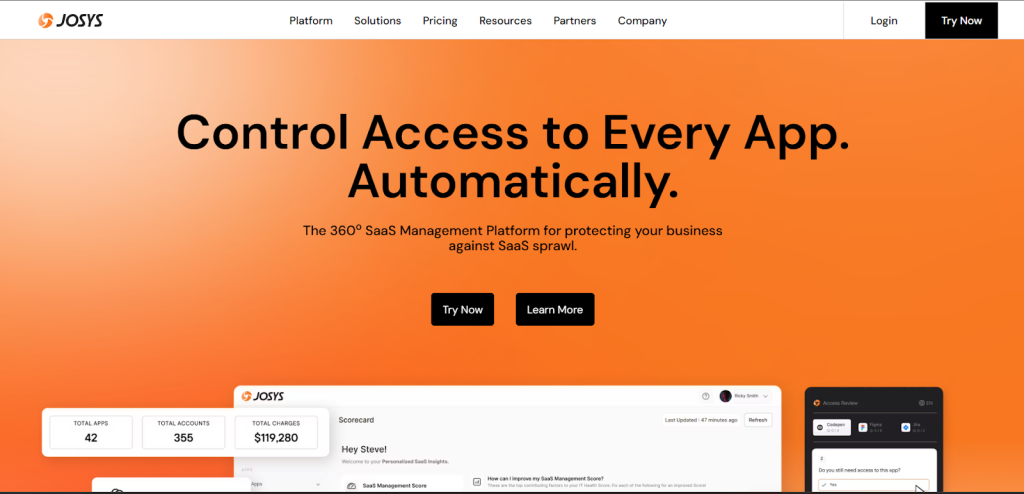
5. Josys—Unified IT Asset and SaaS Management
Josys combines SaaS and physical IT asset management excellently for a complete technology management solution:
- Visibility of hardware assets and SaaS licenses
- User provisioning workflows merged
- Connection to the HR system
Limitations:
- Not as good a SaaS cost optimization as a few other solutions
- A smaller number of integrations is available
- Simple financial controls
Great for companies that have to deal with IT hardware and SaaS.
Platform Capability Comparison
| Feature | Zylo | CloudNuro | Torri HQ | Lumos | Josys |
| Target Market | Enterprise | Enterprise + Mid-Market | Mid-Market | Mid-Market | Mid-Market |
| Platform Coverage | SaaS Only | Unified SaaS, Cloud(Finops) and AI | SaaS Focused | SaaS Only | SaaS + IT Assets |
| Discovery Methods | Finance + SSO | DNS, SSO, IAM, EDR, Finance | SSO + Finance | Identity-Based | SSO + HR Systems |
| License Optimization | Usage-Based | AI Behavioral Rightsizing | Basic Metrics | Basic Reclamation | Usage Monitoring |
| Cloud Cost Management | ❌ | Full Multi-Cloud Optimization | Cost Visibility Only | ❌ | ❌ |
| Chargeback & Cost Allocation | Basic Reporting | Automated G/L Mapping | Manual Config | ❌ | Basic Tracking |
| Governance Automation | Manual Processes | Policy-Driven, Continuous | Alert-Dependent | Access Governance | Asset-Focused |
| Security Features | Basic | Enterprise SSO/MFA | Standard Security | Advanced IAM | Moderate Security |
| Integration Ecosystem | 100+ Apps | 500+ Apps | Moderate | 200+ Apps | 300+ Apps |
| Deployment Speed | Weeks | 15-Minute, 24 Hour Insights | 1-3 Weeks | 1-2 Weeks | 2-3 Weeks |
| Scalability | Enterprise-Proven | Highly Scalable | Mid-Sized Firms | Limited Enterprise Use | Good Scalability |
| Renewal Intelligence | Advanced | Predictive Analytics | Basic Alerts | Basic Alerts | Basic Alerts |
Real-World ROI: How Platforms Like Zylo, CloudNuro, and Torii Drive Enterprise Efficiency
In a time when subscription costs are going up, IT leaders want to see a clear return on investment (ROI) from SaaS management platforms. The news that leading SaaS optimization tools are actually on their way to deliver a high return is quite a relief. Various enterprises that lack proper oversight have been found to waste a quarter of their SaaS budget on licenses that are not used and shadow IT, while the recently released studies indicate the wastage could be as high as 30%. Companies that are equipped with a comprehensive SaaS management platform are able to get back much of this money. Besides the immediate savings that improve the bottom line and enable innovation, the SaaS ecosystem renewal also allows the IT staff to be less burdened with manual license tracking and application audits.
Zylo illustrates well how a drastic cut in costs and increased operational efficiency can be brought about through quality SaaS license management. One of the major asset management software capabilities the platform furnishes the enterprises is the AI-driven visibility into the application utilization along with the proactive renewal tracking. These features make it possible to discover the underutilized tools and eliminate the unnecessary license counts, thus resulting in actual monetary savings and increased software ROI for the organization.
CloudNuro adds more value to the list of benefits by offering a single solution that unifies SaaS, Cloud(Finops) and AI spend optimization. The enterprises using CloudNuro have achieved significant total software and cloud savings that are as high as 20%, on average, through the AI-powered license optimization and multi-cloud cost governance. In addition, to achieve quick value, many companies rely on CloudNuro’s fast implementation (with insights in as little as 24 hours), and thus, the return on investment is realized within the shortest possible time, excluding the change management effort from planning.
At the same time, Torii assists mid-market companies in achieving immediate results through automating SaaS cleanup and license usage optimization. Its platform is capable of identifying which apps are redundant and accounts in which activities have been stopped so that downgrading or removal can be done, and it simplifies onboarding and offboarding tasks. Besides reducing wasted spending, this strategy of Torii increases operational efficiency, thus allowing IT teams to allocate their time and energy to strategic initiatives.
Besides savings that come from reduced expenses, the benefits resulting from the use of SaaS management platforms such as Zylo, CloudNuro, and Torii also include enhanced compliance, audit readiness, and vendor negotiation leverage. When utilizing use-case based real-time analytics and central renewal insights, finance and procurement teams become more efficient in that they can align spending decisions with actual utilization data. The consolidated insight, which allows for a culture of accountability in which every subscription, license, and renewal is tracked, right-sized, and justified, is the main benefit of this unified visibility. As SaaS environments grow, these platforms become not just essential governance layers that integrate cost optimization, security compliance, and strategic planning functions, but also the main instruments that keep technology investment flexible and able to generate new business value continuously.
Evolving Governance: Unified SaaS + Cloud Management Becomes the New Standard
Large companies are abandoning the old way of separately managing SaaS and cloud costs and are instead embracing unified governance frameworks that combine both. In the past, organizations had to use different tools—one for SaaS visibility and another for FinOps—thus creating loopholes in policy enforcement and financial oversight. Nowadays, IT and finance teams are willing to invest in integrated platforms that offer a single view of all digital assets, hence ensuring not only compliance but also cost optimization and operational control.
Unifying SaaS and cloud governance is a good idea that has some advantages besides being more convenient. For example, with a centralized system the security policies can be applied to all teams, the license reclamation can be automated, and multi-cloud spending can be tracked through a single dashboard. Moreover, organizations can also take advantage of predictive renewal planning and chargeback models, which makes it possible to allocate costs directly to the business units, thus turning IT from a cost center into a value-driven partner.
The integration of the three is powered by platforms such as CloudNuro, Zylo, and Torii. With the help of AI-driven automation, CloudNuro’s combined SaaS and cloud management approach enables one to keep up with the on-demand SaaS usage and multi-cloud performance in real time. Zylo keeps on improving features related to vendor visibility and renewal forecasting, while Torii extends automation to facilitate app governance for mid-market teams. The sum of these solutions is an innovation in enterprise technology measurement and control.
Unified FinOps governance is becoming a cloud and SaaS ecosystem’s next big challenge. Those who are integrating SaaS optimization, multi-cloud rightsizing, and access governance in a single platform will realize not only financial clarity but also risk resilience. By doing so, they get to be on the winning side, which features platforms offering this holistic visibility where costs related to SaaS, IaaS, and AI are continuously governed, optimized, and aligned with business outcomes.
Future of SaaS Management: 2025 Trends and Beyond
The market for SaaS management has been completely changed in less than a year. Platforms of today use AI-powered automation that not only predicts app usage, licenses, renewal, and consumption patterns but also changes optimization settings automatically to keep budgets in check. The use of generative AI and machine learning in organizations has become very common to get predictive analytics and automate license reclamation, onboarding/offboarding workflows, renewal scheduling, and many more routine tasks.
- AI-Powered Automation: At present, future usage is predicted by advanced systems, and therefore, they also proactively adjust license allocations so as to avert budget overruns.
- Unified Platforms: Large companies are trying to integrate SaaS and cloud cost management into one single platform, thereby cutting down the need for separate tools for SaaS apps and infrastructure spend..
- Security Integration: Close coupling with SIEM tools lets the system keep an almost uninterrupted eye on data traffic and usage, thereby helping to ensure that compliance requirements are met in the case of all SaaS and cloud services.
- Zero-Trust SaaS Access: The verification of the identity is done continuously (based on context like the device, location, and role), instead of using static access assumptions.
- Behavioral Analytics: More detailed usage information leads to more powerful vendor negotiations and very accurate license rightsizing, which is derived from actual usage patterns.
The shift to unified platforms that merge cloud cost governance with SaaS management is happening simultaneously. Instead of managing several tools for application spend and infrastructure consumption, companies presently demand a single tool to provide full visibility not only for SaaS apps but also for IaaS/PaaS services, subscriptions, and cloud resources. The integration of these different areas enables more accurate cost allocation, chargeback, budgeting, and cross-domain forecasting.
At the same time, the security changes very rapidly as well with deeper integration between SaaS tools and SIEM (security information and event management) that helps in the continuous monitoring of data flows, API access, and third-party integrations. Compliance checks become a routine part of the daily work of the IT and security teams, and thus, they help in usage that is within regulatory and policy boundaries. In the meantime, zero-trust SaaS access is becoming the norm: identity verification is done continuously, context is evaluated for every action, and privileges are dynamically validated.
Another significant trend in behavioral analytics is modern SaaS management solutions that gather detailed usage data, the data that shows which user uses which module, how frequently, and at what time and thereafter uses the same data for vendor negotiation insights and license optimization.
These are the trends that mark the technology governance of tomorrow as SaaS footprints keep on expanding and cloud environments become even more complex. Those platforms that automate processes, bring together SaaS and cloud, maintain continuous identity controls, and exploit the usage patterns will be the ones that are most needed.
Frequently Asked Questions About SaaS Management Platforms
Q: What is a SaaS management platform?
A: A SaaS management platform is a centralized tool that offers visibility, governance, and cost optimization for an organization’s entire software portfolio. It supports SaaS spending management and the elimination of shadow IT.
Q: What are the best SaaS management tools for enterprises?
A: The most significant enterprise SaaS management platforms are CloudNuro (unified SaaS, Cloud(Finops), and AI), Zylo (enterprise standard), Torii (mid-market comprehensive), Lumos (security-first), and Josys (unified IT assets).
Q: How much can SaaS management software save my organization?
A: Typically, organizations can cut down 20-30% of their SaaS costs within the first year by means of SaaS license optimization, app usage elimination, and improving SaaS contract management
Q: What is SaaS spend management?
A: SaaS spend management is essentially about monitoring, analyzing, and optimizing the costs of software subscriptions. This can be done using SaaS expense management tools that display usage patterns and contract terms.
Q: How does SaaS governance work?
A: SaaS governance platforms define the rules for app procurement, user access management, compliance monitoring, and SaaS security management throughout the software ecosystem.
Q: What are SaaS management best practices?
A: The best implementation of SaaS management entails centrally discovering, automating user provisioning, conducting regular access reviews, optimizing SaaS contracts, and continuously monitoring usage.
Q: How long does SaaS management platform implementation take?
A: Platform-dependent is the implementation: CloudNuro can show effects in 24 hours, whereas there may be a 4-6 week period necessary for a fully-fledged deployment of a standard enterprise SaaS management solution.
Q: What is SaaS license management?
A: SaaS license management is about the monitoring, optimization, and rightsizing of software licenses while taking into account actual usage to completely do away with wastage and cut back on costs.
Q: How do SaaS management platforms discover shadow IT?
A: To uncover shadow IT, various data sources such as DNS logs, SSO connections, financial transactions, and endpoint detection are used to identify unauthorized applications.
Q: What is the difference between SaaS management and IT asset management?
A: SaaS management tools concentrate solely on cloud-based software subscriptions, whereas IT asset management provides a comprehensive cover for both physical hardware and software assets.
Q: Can SaaS management platforms integrate with existing systems?
A: Today’s SaaS integration platforms provide vast connectivity with HR systems. financial tools, identity providers, and procurement solutions to automate workflows seamlessly.
Final Recommendation: Choose CloudNuro for Enterprise and Mid-Market Excellence
CloudNuro provides unparalleled clarity, control, and expense optimization across SaaS, cloud, and AI, thus allowing large enterprises and mid-markets to lower their costs and complexity considerably. The company’s quick setup, AI-powered insights, and robust compliance capabilities are the main reasons it is the first choice for organizations committed to SaaS management in 2025.
